What Can a 10kWh Battery Backup Actually Run in Your Home?
A 10kWh battery is one of the most common sizes homeowners ask me about, and the question is always some version of the same thing. Is 10kWh enough, or am I going to run out of power halfway through the night? It’s the right question to ask before you buy, and the answer is refreshingly concrete once you understand how to think about it.
So let’s do exactly that. I’ll show you what 10kWh really means, what it can run and for how long, and where the line sits between “plenty” and “you need more.” By the end you’ll be able to look at your own home and know whether 10kWh is your number.
What 10kWh actually means
First, a quick definition, because the units confuse people. A kilowatt-hour, or kWh, is a unit of energy. One kWh is enough to run a 1,000-watt appliance for one hour, or a 100-watt appliance for ten hours. So 10kWh is a bucket of energy you can spend fast on big appliances or slowly on small ones.
Two numbers matter with any battery. Capacity, in kWh, is how much energy is in the bucket, which sets how long you last. Power output, in kW, is how fast you can pour it out, which sets how much you can run at once. A 10kWh battery has a good-sized bucket. For context, it’s a little smaller than a single Tesla Powerwall 3 at 13.5kWh and about two-thirds of a FranklinWH aPower 2 at 15kWh, so it sits right in the practical range for real homes.
One important note. When a battery is advertised as 10kWh, make sure that’s usable capacity. Quality lithium systems give you nearly all of their rated capacity as usable energy, which is one more reason lithium is the standard for home backup. For this article, we’re assuming 10kWh of usable energy.
The short answer: what 10kWh runs, and for how long
Here’s a realistic look at common household loads and roughly how long 10kWh would run each one on its own. Real numbers vary by model and use, but this gives you an honest feel:
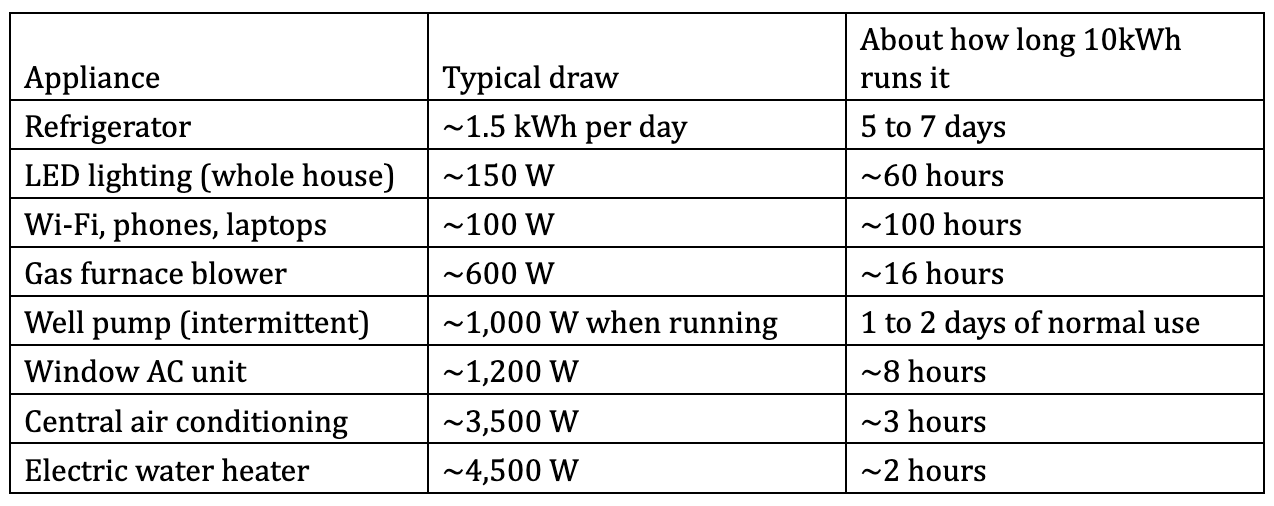
Look at that list and a pattern jumps out immediately. The small, essential loads that keep a household livable barely make a dent, while the big electric loads drain the bucket fast. That single insight is the whole key to sizing.
Running the essentials: 10kWh is genuinely a lot
If you use a 10kWh battery the smart way, backing up your essentials rather than everything, it goes a long way.
A typical Rogue Valley home running just the fridge, freezer, internet, lights, phone charging, and a gas furnace blower uses somewhere in the neighborhood of 8 to 10 kWh over a full day. That means a single 10kWh battery can carry a gas-heated home through roughly a full day, sometimes more, of a normal outage on essentials alone. For the kind of outages we typically see here, that covers the large majority of them comfortably.
If your fridge is really all you’re worried about, 10kWh is almost overkill, and you might even start smaller. If you’re not sure where your must-haves end and your nice-to-haves begin, our refrigerator battery backup sizing guide is a good place to see how the smallest essential load is calculated, then build up from there.
Where 10kWh runs short
Now the honest limits, because I don’t want you buying one battery and being disappointed.
The big electric loads are what drain your 10kWh battery quicker. If you heat your home with electric resistance heat or run central air conditioning, those alone can consume the entire battery in just a few hours. An electric water heater is the same story. This is exactly why your heat source is the single biggest factor in sizing. A gas-heated home can do a lot with 10kWh. An all-electric home that wants to keep the heat pump and water heater running through an outage is going to need considerably more storage, usually two or three batteries.
The other limit is power output, not just capacity. Even if the bucket is full, you can only run so many things at the exact same moment. Trying to start a well pump, a heat pump, and a microwave all at once can exceed the battery’s power rating, regardless of how much energy is stored. Good systems manage this with smart load control, but it’s a reason to design carefully rather than guess. FranklinWh offers the best smart load control featuring an integrated control unit and user friendly app.
Is a 10kWh battery right for your home?
Here’s the simple decision framework I use with people.
A 10kWh battery is likely a great fit if you heat with gas, mainly want to protect essentials like food, heat circulation, water, and communications, and your typical outage lasts under a day. That describes a lot of homes in Southern Oregon and the surrounding area, and for them, one well-chosen 10kWh-class battery is a smart, cost-effective sweet spot.
You probably want more than 10kWh if you heat with electricity or a heat pump, want to keep central air conditioning running, plan to power an electric water heater or EV charging during outages, or want to ride out multi-day winter storms with full comfort. In those cases, plan on stacking capacity. It’s better to know that now than to find out during the first storm.
The way to figure out which camp you’re in is to add up your real essential loads and compare them against that 10kWh bucket. We walk through that exact calculation, step by step, in our guide on how to size and build a home battery backup system.
The bottom line
A 10kWh battery backup is a genuinely capable system that will run your essential household loads for about a day, and specific small loads like your refrigerator for many days. It is not, on its own, enough to run electric heat, central air, or an electric water heater for a long outage. Whether it’s the right size for you comes down to how you heat your home and what you refuse to lose during an outage.
As a certified installer for both FranklinWH and Tesla Powerwall, we help homeowners land on the right capacity instead of guessing, so you don’t overspend on a battery bank you don’t need or come up short when the lights go out. Because the answer really does depend on your specific appliances and panel, the surest way to know is to have us look. If you’d like a precise recommendation, book a free on-site assessment and we’ll run your actual numbers together. No pressure, just straight answers from a local licensed expert.