How to Keep Your Refrigerator Running During a Power Outage: Battery Sizing Guide
Of all the worries that come with a power outage, this is the one that hits first. A fridge and freezer full of food, and the clock quietly ticking on whether it all survives. A few hundred dollars of groceries can spoil in a single long outage, and here in the Rogue Valley, where a winter storm can knock out power for a day or more, that’s a real and repeating cost.
The good news is that keeping your refrigerator running is one of the easiest and most affordable backup projects there is. Let me walk you through exactly how much power a fridge needs, how to size a battery for it, and the two very different ways you can get there.
How much power does a refrigerator actually use?
This trips people up, because a refrigerator’s power use looks scary on paper and is actually pretty gentle in practice.
A typical household refrigerator draws somewhere between 100 and 800 running watts. But here’s the key: the compressor cycles on and off all day rather than running constantly. It’s only pulling full power maybe a third of the time. So while the nameplate number looks big, the real daily energy use of a modern Energy Star fridge is only about 1 to 2 kWh per day. That’s a small, very manageable amount of energy to store.
That low daily number is exactly why a fridge is such a good candidate for battery backup. You’re not trying to power a furnace or an air conditioner. You’re keeping a small, efficient appliance alive.
The startup surge is the part most people miss
Here’s the one spec that catches folks off guard, and it’s the reason cheap backup solutions fail. Every time that compressor kicks on, it demands a startup surge of roughly two to three times its running wattage for a split second. A fridge that runs at 200 watts might spike to 1,200 or even 2,000 watts at the instant it starts.
Your backup power source has to be able to swallow that surge without stumbling. This is why a bargain-bin inverter that claims to handle your fridge’s running watts can still fail the moment the compressor cycles. When you’re choosing any battery solution, look at its surge or peak rating, not just its continuous rating. A quality lithium system with an integrated inverter handles this easily, which is one of several reasons I steer people toward lithium over older battery chemistries for home backup.
How to size a battery to run your fridge
The math here is refreshingly simple. Take how much energy your fridge uses over the time you want to cover, then add a buffer for real-world losses.
A good rule of thumb: a standard home refrigerator needs about 1,500 to 2,000 watt-hours of usable battery capacity to stay cold overnight. In practice, a 2,000 watt-hour battery will typically run a standard fridge somewhere in the range of 8 to 20 hours, depending on the model, how full it is, and how warm the room is.
Here’s a quick way to estimate your own runtime:
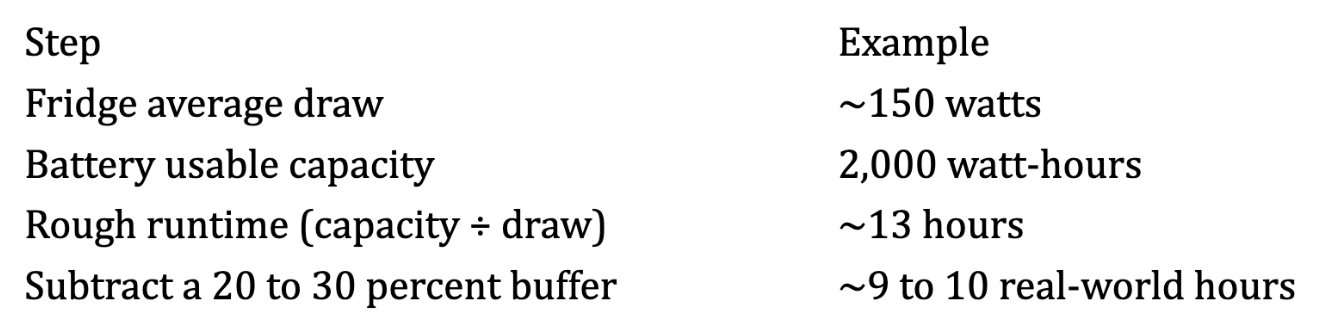
Always build in that 20 to 30 percent buffer. No battery discharges perfectly efficiently, the compressor’s real draw varies, and a warm summer kitchen makes the fridge work harder. Sizing right at the theoretical number leaves you short at the worst moment.
If you want to cover a longer outage, you simply scale up the storage. Doubling the capacity roughly doubles the runtime.
Two ways to back up your refrigerator
This is the real decision, and the right answer depends on what you’re actually trying to solve.
Option 1: A portable power station
A portable power station is a self-contained battery in a box with outlets on the front. When the power goes out, you plug your fridge into it. Something in the 1,500 to 2,000 watt-hour range will keep a fridge cold for the better part of a day, and you can recharge it from a wall outlet once power returns.
The appeal is low cost and zero installation. The downsides are real, though. You have to be home to plug it in, so an outage while you’re at work or away for the weekend still costs you the fridge. It only powers what you physically plug into it. And you’re manually managing the whole thing. It’s a fine solution for occasional, short outages if you’re a hands-on type who’s usually home.
Option 2: An installed home battery
An installed home battery is wired into your electrical panel, so when grid power drops, it takes over automatically. You don’t have to be home. You don’t have to plug anything in. The fridge never even notices the grid went away, and neither do you.
The advantage here is that you’re almost never backing up just the fridge in isolation. For not much more than a fridge-only setup, the same installed battery can also keep your freezer, your internet, some lights, and other essentials running, all automatically. Once you’re looking at a properly installed system, it’s worth understanding what a 10kWh battery backup can actually run in your home, because the jump from “just the fridge” to “the fridge and everything else that matters” is smaller than most people expect. This is the permanent, set-it-and-forget-it answer, and it’s the path most families land on once they’ve lived through one too many outages.
Don’t forget the freezer
If you have a separate chest or upright freezer, factor that into the equation. A freezer has similar power characteristics to a fridge and represents an even bigger pile of food at risk. The nice thing is that a well-stocked freezer holds its cold longer than a fridge when the power’s out, so keeping it topped up with battery power now and then, rather than continuously, is often enough to keep everything frozen through an outage.
A quick Rogue Valley reality check
Our outages here tend to come from winter storms and summer wind events, and they can stretch past 24 hours in the harder-hit areas. That’s the scenario to size against. If your goal is truly never losing food again, whether you’re home or not, a whole-house battery is the tool for the job. If you just want a hedge for the occasional short outage and you don’t mind being hands-on, a portable power station covers the basics, as long as it is properly sized.
If protecting your food is really the first step toward broader energy resilience, it fits neatly into a larger solar and battery backup plan you can build over time, starting small and expanding.
The bottom line
Keeping your refrigerator running through an outage comes down to two numbers: about 1 to 2 kWh of energy a day, and a surge rating high enough to handle the compressor startup. Cover those two things with quality lithium storage and your food is safe. Whether that’s a simple portable station or a fully installed home battery depends on how often you lose power and whether you want it handled automatically.
As a certified installer for both FranklinWH and Tesla Powerwall, we can set up a system that protects your fridge and freezer today and expands to cover the rest of your home whenever you’re ready. Every kitchen and panel is a little different, so the exact right size for your home is something we’d confirm on site. If you’d like a real recommendation, book a free on-site assessment and we’ll size it to your actual appliances. No pressure, just honest numbers from a local licensed expert.