How Much Do Solar Panels Cost for a 3-Bedroom House in Oregon?
If you’ve got a standard three-bedroom home in the Rogue Valley and you’re wondering what solar would actually cost you out of pocket, you’ve come to the right place. Not a vague “it depends,” but real numbers you can plan around.
I’ll give you honest figures, show you exactly how we get to them, and walk through what the payback really looks like here in Southern Oregon in 2026. I’ll also be straight with you about the federal tax credit situation, because it changed recently and a lot of what’s online is out of date.
The short answer
For a typical three-bedroom house in Oregon, you’re generally looking at a solar system somewhere in the range of 6 to 7 kilowatts. At our pricing, that lands roughly between $15,000 and $19,000 installed, before we talk about any incentives.
That’s a real number, but the honest truth is that your exact cost depends on your roof, your electrical panel, and most of all how much electricity your household actually uses. Let me show you how those pieces fit together so the number makes sense.
How big a system does a 3-bedroom house need?
Bedrooms don’t use electricity. People and appliances do. So when someone asks about a “three-bedroom house,” what really matters is the power bill behind it.
A typical three-bedroom Oregon home uses somewhere around 8,000 to 10,000 kWh per year, though that swings a lot based on whether you heat with gas or electricity, whether you have air conditioning, and whether there’s an EV in the driveway. To offset most of that usage here in the Rogue Valley, most homes need a system in the 6 to 7 kW range. Homes with electric heat, a heat pump, or an EV often need more.
The reason our region works well for solar is that Medford and the surrounding valley get strong sun, around 196 sunny days a year, which is among the best in Oregon. A 6 kW system here typically produces between about 6,800 and 8,500 kWh per year, with our area landing on the higher end of that range thanks to clear skies.
Why price per watt is the number that actually matters
Here’s the single most useful concept for comparing solar quotes: price per watt, written as $/W. You take the total system cost and divide it by the system size in watts. It lets you compare a 6 kW system against a 7 kW system fairly, apples to apples, because it strips out the size difference.
This is where it pays to understand the market, because prices vary widely depending on who you buy from.
The U.S. Department of Energy’s national lab, NREL, pegs the benchmark cost of residential solar at about $3.25 per watt. The big national installers you see advertising on billboards or social media often run higher, anywhere from about $3.00 to over $4.00 per watt, with some quotes reaching $4.75. Online marketplaces that gather competing quotes report an Oregon average around $2.49 per watt as of mid-2026.
We price our solar projects between roughly $2.40 and $2.75 per watt. That sits below the national benchmark and well under what the big national companies charge. The reason is simple and I’ll be transparent about it. We keep our overhead low. We’re a lean local business, not a national sales operation with an army of commissioned salespeople and a huge marketing budget baked into every quote. That efficiency goes straight into your price instead of into our overhead.
A real cost example
Let’s put actual numbers on a few common system sizes at our pricing versus the national benchmark, so you can see the difference:
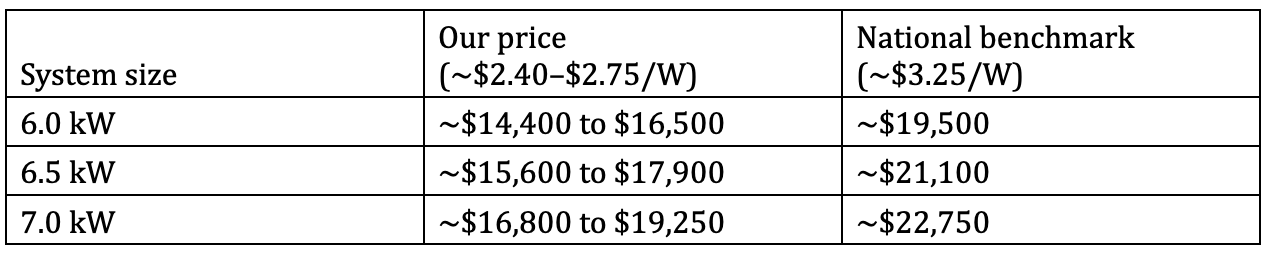
On a typical three-bedroom system, that pricing gap can put several thousand dollars back in your pocket compared to a national installer, for the very same size system.
What about incentives?
This is where I have to correct some outdated information you’ll find online.
The 30 percent federal residential solar tax credit is gone. It ended for systems placed in service after December 31, 2025. Many online articles, outdated websites, and unfortunately some sales pitches, still quote that 30 percent as if it’s available. For a 2026 installation, it is not available for homeowners that want to own their system outright. You should budget your project as if that federal credit does not exist, because it doesn’t.
There is still some incentive support at the state level in Oregon, primarily through Energy Trust of Oregon, which offers help on qualifying projects. Eligibility depends on your utility and the program’s specific requirements, so it’s worth checking whether your situation qualifies rather than assuming.
The other piece worth knowing is net metering. In Oregon, Pacific Power offers 1-1 net metering, which lets the excess power your panels make during sunny days offset the power you pull from the grid at other times. I like to tell homeowners to think of net metering as a virtual battery bank. Power you don’t use gets stored in a virtual bank as a credit that you can pull from later in the year. That’s a meaningful part of what makes the economics work, and it’s available regardless of the tax credit changes. Not all utilities in Oregon offer 1-1 net metering, so it’s important to do your research, especially if you get electricity from a municipal utility.
So what’s the payback in Southern Oregon?
Let’s do the real math on a representative system. Take a 6.5 kW system at around $16,000 installed at our pricing. In our sunny part of the state, that system might produce roughly 8,500 to 9,000 kWh a year. At Oregon’s residential electricity rate of around 13.5 cents per kWh, that’s about $1,150 to $1,200 in electricity you’re no longer buying, in the first year alone.
That puts simple payback somewhere in the range of 12 to 14 years at today’s rates. But two things push that payback sooner in practice. First, Pacific Power’s rates have been climbing, and every rate increase makes your solar savings larger, which shortens the payback. Second, quality panels are warrantied for 25 years and keep producing well beyond that, so after the system pays for itself you’re looking at a decade or more of essentially free electricity.
I want to be honest here: without the federal tax credit, solar payback in Oregon is longer than it was a couple of years ago. It’s a long-term investment, not an overnight win. But for a homeowner planning to stay in their house, facing rising utility rates, it still pencils out to real savings over the life of the system, and our lower pricing is a big part of what keeps that math working. If you end up selling your home before your break even point, you will still reap the benefits of an increased home value having solar on your roof.
Is solar worth it for a 3-bedroom house in the Rogue Valley?
For most three-bedroom homeowners here who plan to stay put for the long haul, yes. You’re trading a large but one-time cost for decades of dramatically reduced power bills, and you’re locking in your rate against a utility that keeps raising theirs. The case is strongest if you use a fair amount of electricity, you’re staying in the home, and you can either pay cash or finance at a reasonable rate.
If you have a larger home or bigger energy needs, the numbers and system sizing shift, and it’s worth reading our companion breakdown on the true cost of solar panels for a 4-bedroom house in Southern Oregon to see how a bigger system compares. And once you’re ready to actually choose an installer, our guide on how to choose the best local solar installers in Southern Oregon will help you avoid the national sales traps.
The bottom line
A solar system for a typical three-bedroom Oregon home runs about 6 to 7 kW and costs roughly $15,000 to $19,000 at our pricing, which is much less than the national-average and big-installer numbers you’ll see quoted. The federal credit is gone, but strong local sun, net metering, and rising utility rates still make it a sound long-term investment for homeowners.
The one thing no article can do is give you an exact number, because it depends on your actual roof, panel, and power usage. That’s what an on-site visit is for. If you’d like a precise system size and a real quote for your home, book a free on-site assessment and we’ll put honest figures in front of you. No pressure, no national-sales runaround, just straight numbers from a local licensed eexpert. You can also see how your project fits into the bigger picture of solar panel costs across Oregon.