Sizing Up: The True Cost of Solar Panels for a 4-Bedroom House in Southern Oregon
A four-bedroom house is a different animal than a smaller home when it comes to solar. More space usually means more people, more appliances, and a bigger power bill, which means you need a bigger system to make a real dent. So the honest cost is higher, but here’s the part most people don’t expect: the return can actually be stronger.
Let me walk you through what a solar system really costs for a four-bedroom home here in the Rogue Valley, how the economics compare to a smaller system, and what the payback looks like in 2026. I’ll also give you the full story on the federal tax credit, because it has a long and changing history and it matters a lot to your numbers.
The short answer
For a typical four-bedroom home in Southern Oregon, you’re generally looking at a system in the 8 to 10 kilowatt range. At our pricing, that lands roughly between $19,000 and $27,000 installed, before any incentives.
That’s a wide range because four-bedroom homes vary a lot. A household heating with natural gas and no EV sits at the lower end. A busy family with electric heat, air conditioning, and a car in the garage that needs charging sits at the top, or beyond it. As always, it’s your power usage, not your bedroom count, that sets the real number.
Why a bigger house needs a bigger system
A four-bedroom home in Oregon commonly uses somewhere in the range of 10,000 to 14,000 kWh a year, noticeably more than a smaller home. To offset most of that here in the Rogue Valley, most of these homes need a solar system in the 8 to 10 kW range.
The good news is our location does a lot of the heavy lifting. Medford and the surrounding valley get strong sun, among the best in the state, so each kilowatt of panels you install produces roughly 1,300 to 1,400 kWh a year here. That means a 9 kW system on a Rogue Valley roof can produce somewhere around 12,000 kWh annually, enough to cover most or all of a typical four-bedroom home’s usage.
The cost, and a bit of good news on scale
Here’s a look at real numbers for common four-bedroom system sizes at our pricing, next to the national benchmark, so you can see where you stand:
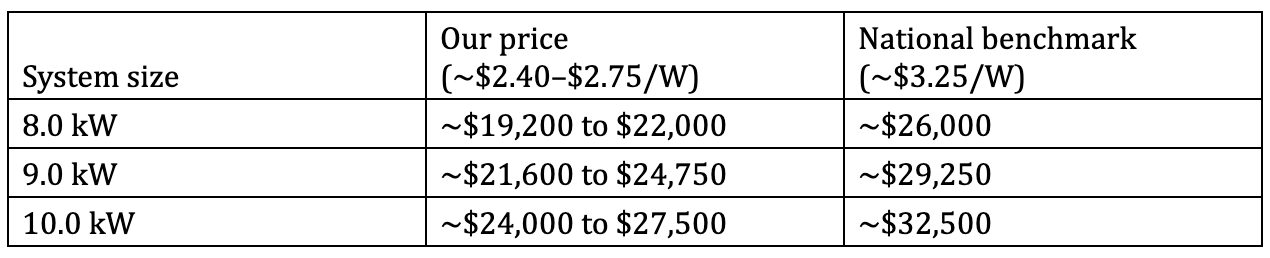
Notice the gap between our pricing and the benchmark widens as the system grows. On a 10 kW system, buying from a lean local business instead of a national sales operation can save you well over $5,000 for the same hardware on your roof. That’s because a lot of a big installer’s price is fixed overhead and sales commission that gets spread across every job, and it stings more on a larger system. We keep our overhead low as a startup, and that savings goes to you.
There’s also a modest economy of scale on the equipment and labor side. Doubling your system size doesn’t quite double every cost, so larger systems often come in at a slightly better price per watt. For a four-bedroom home that genuinely needs the capacity, that works in your favor.
If you want to see how this compares against a smaller build, our breakdown of the cost of solar panels for a 3-bedroom house in Oregon lays out the numbers for a 6 to 7 kW system side by side.
The federal solar tax credit: what it was, and what happened to it
You cannot talk honestly about solar cost in 2026 without explaining this, because the ground shifted at the end of 2025 and most of the internet hasn’t caught up.
For most of the last two decades, a federal tax credit made solar meaningfully cheaper for homeowners. Here’s the real timeline, because the history matters:
The credit was born with the Energy Policy Act of 2005, which established a 30 percent federal Investment Tax Credit for solar starting in 2006. In 2008 it was extended and removed the old cap on the residential credit, which is when home solar really started to take off.
Then in 2015, Congress set a long-term schedule with a planned step-down: 30 percent through 2019, then 26 percent, then 22 percent, on its way to phasing out for homeowners. The Inflation Reduction Act in 2022 then reversed that decline and restored the full 30 percent credit, extending it all the way out to 2032 before any step-down. For a few years, homeowners had a generous and stable 30 percent credit to count on.
That changed on July 4, 2025, when the One Big Beautiful Bill Act was signed into law. It eliminated the residential solar tax credit, known as the 25D credit, for systems installed after December 31, 2025. So as of 2026, a homeowner who buys and installs their own solar system no longer receives that 30 percent federal credit. It is gone, not reduced.
I’m spelling this out because a huge amount of online content, and unfortunately some sales pitches, still advertises “30 percent off with the federal tax credit.” For a 2026 purchase, that is simply not accurate anymore. Budget your project as if the federal credit does not exist, because for a standard homeowner purchase, it doesn’t.
What incentives remain in 2026
Oregon still offers some incentive support at the state level, primarily through Energy Trust of Oregon, for qualifying projects. Whether you qualify depends on your utility and the program’s specific rules, so it’s worth checking your own situation rather than assuming.
The bigger ongoing benefit is net metering. Pacific Power offers net metering in Oregon, which lets the surplus power your panels produce on sunny days offset the grid power you use at night or in winter. For a four-bedroom home with high usage, strong net metering is a major part of what makes the economics work, and it’s unaffected by the federal credit changes.
Payback and ROI for a 4-bedroom system
Let’s run real numbers. Take a 9 kW system at around $23,000 installed at our pricing. In our sunny valley, it might produce roughly 12,000 kWh a year. At Oregon’s residential rate of about 13.5 cents per kWh, that’s around $1,600 a year in electricity you stop buying, right out of the gate.
That puts simple payback in the range of roughly 12 to 14 years at today’s rates. And here’s where the bigger system can actually shine. Larger homes tend to use more of their own solar power directly, and they’re exposed to more of Pacific Power’s rate increases, so every future rate hike saves them more. Combine that with panels warrantied for 25 years, and a four-bedroom home often sees a decade or more of strong savings after the system has paid for itself.
I’ll be straight with you, the same way I was on the smaller home. Without the federal credit, payback is longer than it was a couple of years ago. This is a long-term investment, not a quick flip. But for a high-usage household planning to stay in their home, the larger system frequently delivers a better lifetime return than a smaller one, simply because it offsets more expensive grid power every single year.
Is the bigger system worth it?
For most four-bedroom families in the Rogue Valley who plan to stay put and use a fair amount of electricity, yes. You’re offsetting a larger bill, capturing more value from every rate increase, and locking in decades of lower energy costs. The case is strongest when your usage is genuinely high, which is exactly the situation most four-bedroom homes are in.
When you’re ready to actually pick a company to do the work, do it carefully, because this is where a lot of homeowners get oversold. Our guide on how to choose the best local solar installers in Southern Oregon will help you separate honest local contractors from national sales machines.
The bottom line
A solar system for a four-bedroom Southern Oregon home typically runs 8 to 10 kW and costs roughly $19,000 to $27,000 at our pricing, thousands less than the national-average figures, with the savings gap growing on larger systems. The federal tax credit that helped for nearly twenty years ended for 2026 installs, but strong local sun, net metering, and rising utility rates keep solar a sound long-term investment for high-usage homes.
Your exact number depends on your roof, your panel, and how much power your household actually uses, which no article can calculate for you. If you’d like a precise system size and an honest quote, book a free on-site assessment and we’ll run your real figures together. No pressure, no national-sales runaround, just straight numbers from a local licensed expert. You can also see the full picture of solar panel costs across Oregon to understand how your project fits in.