Why Lithium Batteries are the Gold Standard for Home Energy Storage
If you’ve started shopping for a home battery, you’ve probably noticed that lithium systems cost more upfront than old-school lead-acid batteries, and you’ve probably wondered whether that premium is worth it. It’s a fair question, and it’s the right one to ask before you spend the money.
I’ll give you the straight answer as someone who installs these for a living. For a home backup system that you want to set up once and rely on for the next decade or more, lithium isn’t just the better option. It has become the standard for good reason. Let me show you exactly why, including the honest tradeoffs, so you understand what that higher sticker price actually buys you.
First, a quick tour of your options
When people say “home battery,” they’re usually talking about one of two broad families.
Lead-acid batteries are the old, familiar technology, the same basic chemistry that’s been starting cars for a century. They’re cheap to buy and they work. Deep-cycle versions have been used for off-grid power for decades.
Lithium batteries are the newer generation, and within that family the important one for home use is lithium iron phosphate, often written as LiFePO4 or just LFP. The leading home systems today, including the FranklinWH and Tesla Powerwall lines, are built on LFP chemistry. There’s also an older lithium type called NMC, and the difference between LFP and NMC matters a lot for safety, which I’ll come back to.
The reason lithium has taken over isn’t hype. It’s what happens when you look past the sticker price and compare what you actually get.
Why lithium wins: it’s about usable energy, not just capacity
Here’s the single most important thing to understand, because it’s where most of the value hides.
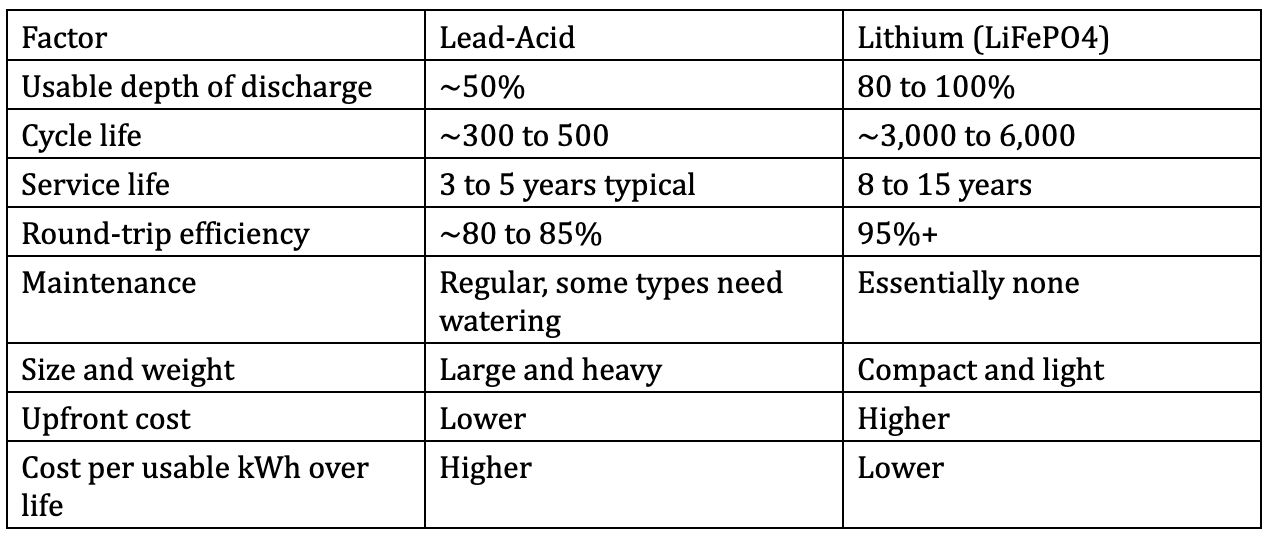
A battery’s rated capacity is not the same as the energy you can actually use. Lead-acid batteries should not be discharged below about 50 percent of their rating, because doing so damages them and shortens their life dramatically. That means a 10 kWh lead-acid bank really only gives you about 5 kWh of usable energy. Lithium, on the other hand, can safely be discharged to 80 to 100 percent of its rating. A 10 kWh lithium battery gives you 8 to 10 usable kWh.
So before you’ve even talked about lifespan, lithium delivers nearly double the usable energy per rated kWh. When you compare prices, you have to compare usable energy, not nameplate capacity, or you’re fooling yourself.
The lifespan gap is enormous
This is where the upfront premium pays for itself, and then some.
A lead-acid battery typically lasts somewhere around 300 to 500 charge cycles before it’s worn out. A quality LiFePO4 battery is rated for roughly 3,000 to 6,000 cycles, which translates to a service life of about 8 to 15 years. That’s not a small edge. It means that over the life of a single lithium battery, you might buy, replace, and dispose of lead-acid banks several times over.
When you do the real math, cost per usable kWh over the life of the system, lithium is usually the cheaper option, not the more expensive one. The higher price tag is really just paying more of the total cost upfront instead of in repeated replacements down the road.
Head to head
Here’s the comparison I draw for people at the kitchen table:
The efficiency difference you’ll actually feel
Lithium batteries are more than 95 percent efficient, meaning almost all the energy you put in comes back out. Lead-acid loses more of that energy to heat and internal resistance, often landing well below lithium. For a grid-charged backup system, that efficiency is money. Every kWh you lose to inefficiency is a kWh you paid for and never got to use. Over years of charging and discharging, that adds up.
Lithium also charges faster and handles the demanding startup surges from things like your refrigerator’s compressor without breaking a sweat. That surge capability is a big part of why lithium is the right foundation for backing up a refrigerator and other essential appliances reliably.
Maintenance, size, and the things you stop worrying about
There’s a quality-of-life dimension here that spec sheets don’t capture. Lead-acid banks are large, heavy, and some types need periodic maintenance, including checking and topping off fluid and managing ventilation for the gases they release. Lithium systems are compact, sealed, wall-mountable, and essentially maintenance-free. You install it and forget it. For a battery living in your garage or on the side of your house for the next decade, that difference matters more than people expect.
A word on safety and chemistry
Safety is a completely reasonable thing to think about with any battery, and it’s worth being precise here rather than vague.
Within the lithium family, LiFePO4 is notably more stable than the older NMC chemistry. LFP has a much higher tolerance before it reaches thermal runaway, which is the failure mode people worry about. This is a major reason the leading home battery makers moved to LFP for residential products. It’s the safer lithium chemistry, and it’s what’s inside the systems we install. If safety is on your mind, and it should be, it’s worth reading our full breakdown of how safe home lithium batteries really are and how thermal runaway works, because there’s a lot of misinformation out there and the real picture is reassuring when the system is quality gear, installed correctly.
So is the lithium premium worth it?
For a permanent home energy storage system, yes, almost always. You’re paying more upfront to get nearly double the usable energy, a lifespan several times longer, far better efficiency, no maintenance, and a smaller, safer package. Spread across 10 to 15 years, lithium is typically the lower total cost, not the higher one.
The one place lead-acid still occasionally makes sense is a very small, budget, off-grid project where the upfront dollars matter more than long-term value, and the owner is comfortable maintaining it. For a whole-home backup system you want to trust during a winter storm, that’s not the situation, and lithium is the clear call.
As a certified installer for both FranklinWH and Tesla Powerwall, we work with LFP lithium systems day in and day out, and we can walk you through exactly which one fits your home and your budget. Since the right size and configuration depend on your specific loads and panel, the best next step is a real look at your setup. If you’d like a personalized recommendation and quote, book a free on-site assessment and we’ll go through it together. No pressure, just honest guidance from a local licensed electrician.