Battery vs. Generator in Wildfire Country: An Honest Comparison
If you want to keep your home powered through an outage, you have two main choices: a generator or a home battery. Both work. They’re just good at different things. We install batteries, so you know where we’re coming from, but here’s the honest version, including where a generator has the edge.
How each one works
A generatorburns fuel with either gasoline, propane, or natural gas to make electricity on demand. There are two main types: a portable unit you roll out and start yourself or a standby (whole-home) generator that is permanently installed and starts automatically when the power drops.
A home battery stores electricity ahead of time and automatically releases it when the grid goes down. No fuel, no engine, no to little maintenance. Paired with solar, the battery recharges from your panels during the day, which matters a lot in a multi-day outage. A standalone home battery without solar will charge from the grid and sit idle until an outage.
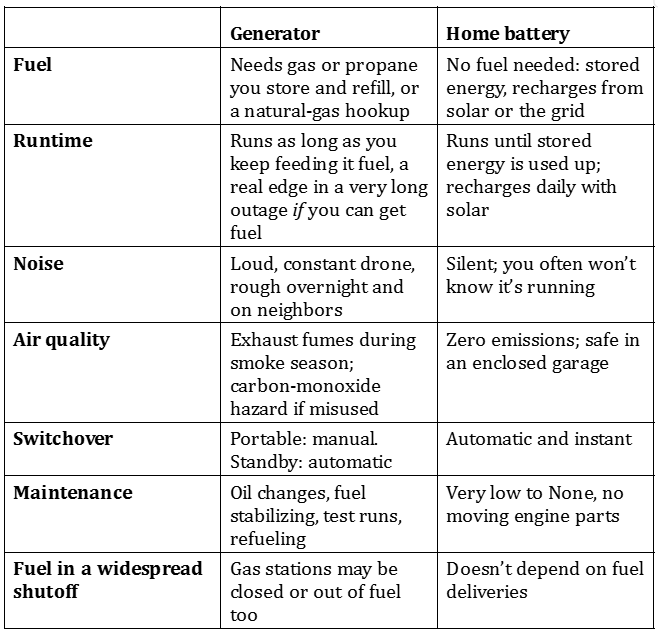
The honest side-by-side
Where a generator wins
Let’s be fair: runtime is a generator’s real strength. As long as you can keep feeding it fuel, it’ll run indefinitely. If you expect very long outages, you’re comfortable storing and handling fuel, and you have reliable fuel access, a generator can absolutely make sense.
The catch is right there in the fine print: if you can get fuel. During a widespread fire-season shutoff, the gas stations near you may be dark too, and stored fuel goes bad if it isn’t managed. Runtime is only an advantage when the fuel supply holds.
Where a battery wins
A battery’s advantages line up almost perfectly with a Rogue Valley fire-season shutoff:
It’s automatic and instant. No going outside at 2 a.m. to pull a starter cord, the switchover happens on its own.
It’s silent. No engine droning through the night for you or your neighbors.
It’s clean. No exhaust, which matters when the outage is happening because of fire and the air might be thick with smoke. A battery is safe to run in an enclosed garage; a generator is not.
It’s low-maintenance. No oil, no fuel to stabilize, no test runs.
It doesn’t need a gas station. It never depends on fuel deliveries or open stations during an emergency.
The trade-off is honest: a battery’s runtime is set by how much energy it stores, so sizing it correctly to your home is everything. That’s exactly what a battery backup analysis figures out, see how to size a home battery backup system for how the sizing works.
So which should you choose?
Plainly:
A generator makes sense if you prioritize raw runtime, you’re set up to store and handle fuel, and you have dependable fuel access.
A battery makes sense if you want backup that’s automatic, silent, clean-running, and maintenance-light to free, which is what most of our neighbors want when the outage is a smoky, days-long fire-season shutoff.
A lot of folks here simply don’t love the idea of running a loud, exhaust-belching engine in the driveway during the smokiest week of the year while a fire burns over the ridge. That’s a personal call, and it’s a fair one, typically driven by what you want and what you can afford.
I will say, if you are going solar and you want protection from an outage, it just makes sense to go with a battery. The Tesla Powerwall is a streamlined solution that integrates both the Solar Inverter and Battery into one unit. It turns what was once a complicated design, into an easy, almost, plug and play solution. Concentric Solar is a certified Tesla Powerwall installer for this very reason.
The bottom line
Generators win on raw runtime if you can get fuel. Batteries win on being automatic, silent, clean, and low-no maintenance. Batteries never need a gas station to be open or need regular routine maintenance. The right answer depends on your home, your budget, and ultimately your goals. If you want to explore your options, book a free on-site assessment and we’ll map out your best path. No pressure, just straight answers from a local licensed electrician.