The Best Whole-House Battery Backup Systems (No Solar Required)
So if you read the first post, you’ve already worked out that a home battery can absolutely run without solar panels. Now comes the harder question, and it’s the one I get asked most often once a homeowner in Medford or Ashland has made up their mind: which one should I actually buy?
There’s a lot of noise out there, and most of the “best battery” lists are written for people who are buying solar at the same time. That’s a different product category than battery backup without solar, and the distinction matters more than the marketing lets on. That changes the answer. When you’re charging strictly from the grid, some of the specs everyone brags about stop mattering, and one spec almost nobody mentions becomes the most important one on the sheet. Let me walk you through it the way I would in person.
First: the one spec that matters most when you’re skipping solar
Here it is, and it’ll save you thousands of dollars: pay attention to whether the battery is AC-coupled or DC-coupled.
A DC-coupled battery has a solar inverter built into it. That’s a genuinely great feature - if you’re installing solar panels. The battery’s inverter converts DC power from your panels directly, which is efficient and tidy. But if you don’t have panels, that expensive built-in solar inverter just sits there doing nothing. You paid for hardware you’re not using.
An AC-coupled battery, by contrast, connects to your home’s existing AC electrical system. It doesn’t need or expect panels. It charges from whatever the grid hands it, and it plays nicely with any setup you already have. For a grid-charged backup system, AC-coupled is usually the more sensible buy.
That said, there’s a real counterargument I always raise: if you think you’ll add solar within a few years, buying a DC-coupled unit now means you won’t have to reconfigure anything later. It’s a “pay a little now to save a headache later” decision, and it depends entirely on your plans. You can add solar panels to both an AC-coupled and DC-coupled battery at a later time, but DC coupled will win the efficiency debate when paired with solar.
What “best” actually means for a no-solar backup system
Before I name names, here’s the checklist I run through with clients. “Best” isn’t one battery, it’s the one that matches these five things to your house.
Usable capacity (kWh). How much energy is stored. This determines how long you run during an outage.
Continuous power output (kW). How much you can run at the same time. This is the spec that determines whether you can operate a well pump and a heat pump simultaneously, or just the fridge and some lights. Homeowners consistently underestimate this one.
Surge / motor-start capability. Well pumps, AC compressors, and shop tools spike hard for a split second when they kick on. A battery that can’t handle that surge will trip, no matter how much capacity it has. If you’re on a well in the Rogue Valley, this spec matters enormously.
An included transfer switch or gateway. Some systems bundle the automatic transfer switch and smart-circuit control into one unit. Others make it a separate purchase and a more complex install, which ultimately means more labor cost on your invoice.
Grid-charge scheduling and warranty. Can you tell it to charge overnight? And how long is it guaranteed - years, cycles, or total energy throughput?
The best home battery backup systems without solar in 2026
FranklinWH aPower 2 - best overall for whole-home, no-solar backup
If you want one recommendation for a grid-charged whole-house system, this is usually it. The aPower 2 delivers 15 kWh of usable capacity with 10 kW continuous output with a 15 kW surge (185 LRA). This is the largest single-unit residential capacity on the market right now. It’s AC-coupled, so it doesn’t assume you have panels and doesn’t charge you for an inverter you won’t use.
The bigger deal is the aGate controller it pairs with. That unit bundles the automatic transfer switch and smart circuit management into one enclosure, which simplifies the installation considerably and gives you real control over which circuits get backed up and in what priority. Warranty runs 15 years or 60 MWh of throughput. Expect roughly $16,500 installed with the FranklinWH system.
The 15 kW surge is why I lean on this one for rural Rogue Valley properties with well pumps as well as the ability to integrate a stand alone generator. Together, this makes it hit number one on my list.
Tesla Powerwall 3 - best if solar is in your future
The Powerwall 3 offers 13.5 kWh with a strong 11.5 kW continuous output and excellent motor-start capability (185 LRA), which handles heavy appliances well. It runs about $15,400 installed, and Tesla’s app is the best in the business; clean, informative, and genuinely useful during an outage.
Here’s the honest caveat. The Powerwall 3’s headline feature is a built-in hybrid solar inverter (up to 20 kW DC across 6 MPPTs). In a no-solar install, that capability is dormant. You’re buying a superb piece of hardware and leaving its best trick on the table.
It absolutely works as backup-only and Tesla supports this configuration with a Backup Gateway or Backup Switch. One setup note worth knowing: when grid charging is enabled, Powerwall’s logic normally charges from the grid when there isn’t enough solar to hold your backup reserve, or when time-based rates make it worthwhile. With no solar in the picture, it simply charges from the grid. There’s also a Storm Watch feature that automatically fills the battery to 100% when severe weather is forecast. This is a legitimately excellent feature heading into a Rogue Valley winter or a wildfire-season shutoff warning.
Verdict: if panels are likely within a few years, this is the smart long game. If you’re certain you’ll never go solar, you’re overpaying for an idle inverter.
Enphase IQ Battery 10C - best modular, essentials-only option
The Enphase IQ 10C is a different philosophy: small building blocks instead of one big box. Each unit is 10 kWh with 7.08 kW continuous (surging to 13.44 kW for 3 seconds), and runs about $14,000 installed per unit.
The appeal is a lower entry price and the ability to start small and add later. The catch is arithmetic: reaching meaningful whole-home backup usually takes 2 to 4 units, and at that point your cost per kWh is higher than the big single-unit systems. The warranty is strong, though: 15 years or 6,000 cycles. Enphase is brand with huge recognition and can be easily retrofitted with it’s solar system at a later time.
Best fit: a smaller home in Talent or Phoenix that wants essentials covered without breaking the bank, or someone who wants to expand gradually over time.
Comparison at a glance
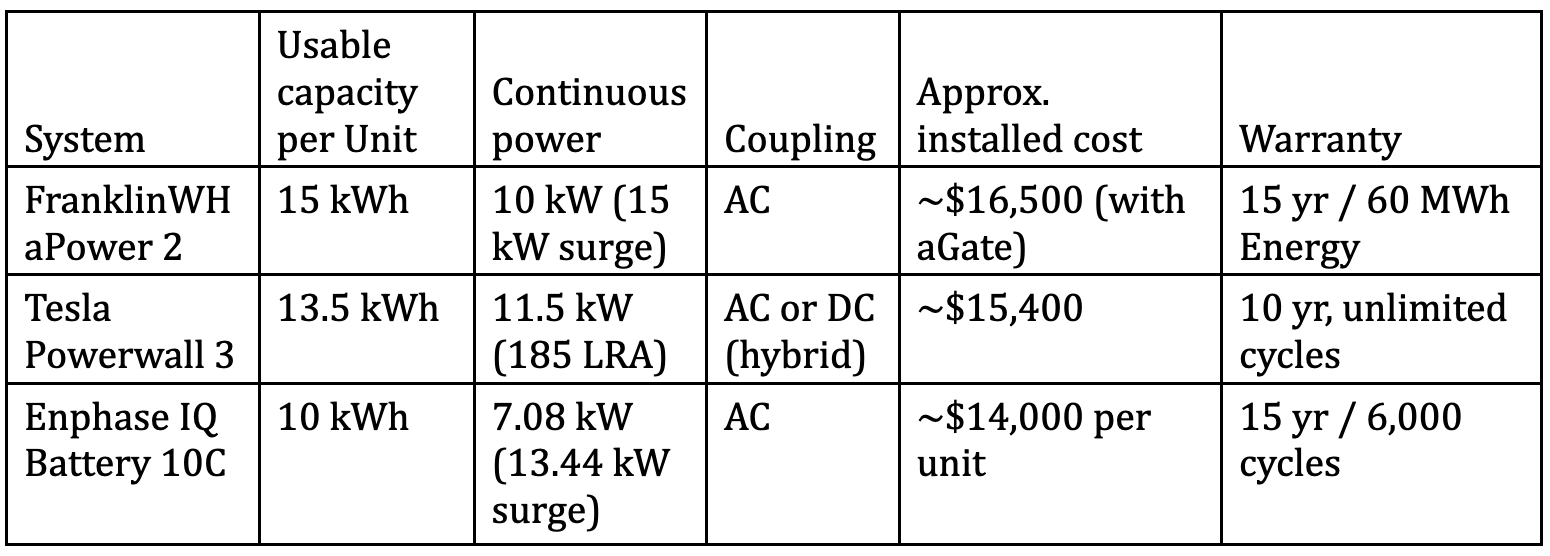
Prices are ballpark figures for planning. Your actual number depends on your panel, your loads, and the labor your specific install requires.
So how many batteries do you actually need?
This is where most people go wrong, in both directions. Some buy far more than they need, others buy one unit and are disappointed when it won’t run the air conditioning.
The short version: backing up essentials only (refrigerator, freezer, Wi-Fi, lights, furnace blower, well pump) is dramatically cheaper and stretches your runtime a long way, and a single unit handles it comfortably. Backing up everything, including central AC, a heat pump, or an electric water heater, generally takes two or three units.
The real work is a load calculation: adding up what you actually want running and for how long. Our guide to sizing and building a home battery backup system walks through exactly how to do that math against your own panel and appliances. Don’t skip it, it’s the difference between a system that works with you and one that frustrates you.
What Rogue Valley homes specifically should weigh
A few local realities change the calculus here:
Well pumps are common outside city limits, and they need surge headroom. Favor high surge ratings.
Cold garages affect batteries. If the unit is going in an unheated detached garage in the hills, check the operating temperature range and think about placement. Deep cold degrades performance and available capacity. Most of these batteries can still charge and discharge below freezing, but it’s best to do your homework so it doesn’t disappoint in a winter snow storm.
Our outages are usually hours, not days. Between summer thunderstorms, winter ice on the lines, and wildfire-season Public Safety Power Shutoffs, most Pacific Power outages here resolve within a day. That means a single well-sized battery genuinely covers the large majority of what you’ll face. You don’t automatically need a bank of three and all options can be added to in the future.
If your goal is full independence, rather than storm insurance, the equation changes and solar re-enters the conversation. Our guide to the best off-grid solar installers near Talent, Oregon covers what going fully independent actually requires.
The bottom line
For most Rogue Valley homeowners who want whole-house backup and aren’t installing panels, the FranklinWH aPower 2 is the strongest all-around choice: big capacity, high surge, AC-coupled, and an integrated gateway that keeps the install clean. It is the set it and forget option. If solar is genuinely in your five-year plan, the Powerwall 3 is the better long game. If you want to start small and build, the Enphase IQ 10C is the affordable on-ramp.
But I’ll be straight with you: the “best” battery on paper is not always the best battery for your house. It depends on your electrical panel, your well pump, whether you heat with gas or a heat pump, and what you’re truly unwilling to lose during an outage. Nobody can calculate that accurately from a website and it takes someone standing at your panel with the knowledge and experience with these systems.
If you want real numbers instead of ranges, book a free on-site assessment and we’ll size a system to your actual home and tell you honestly which of these makes sense — and which doesn’t.